


Este artigo também está disponível em português.
In July, VillageReach reached an important milestone in moving peer-to-peer learning to improve immunization outcomes from ideas into action. The P2P Learning to Improve HPV Vaccination Coverage program, co-implemented by BCL, enabled health workers, teachers and community actors to put skills and knowledge gained through the initiative into practice, and began community-based efforts to improve local knowledge, access and demand for HPV vaccination.
The work comes at an important moment for HPV vaccination. Globally, just 33% of girls received at least one dose of HPV vaccine in 2025—well short of the scale required to achieve the World Health Organization’s goal of having 90% of girls fully vaccinated against HPV by age 15 by 2030. Approaches that equip health workers and trusted community actors to share knowledge, address concerns and learn from one another can help turn vaccine availability into vaccination.
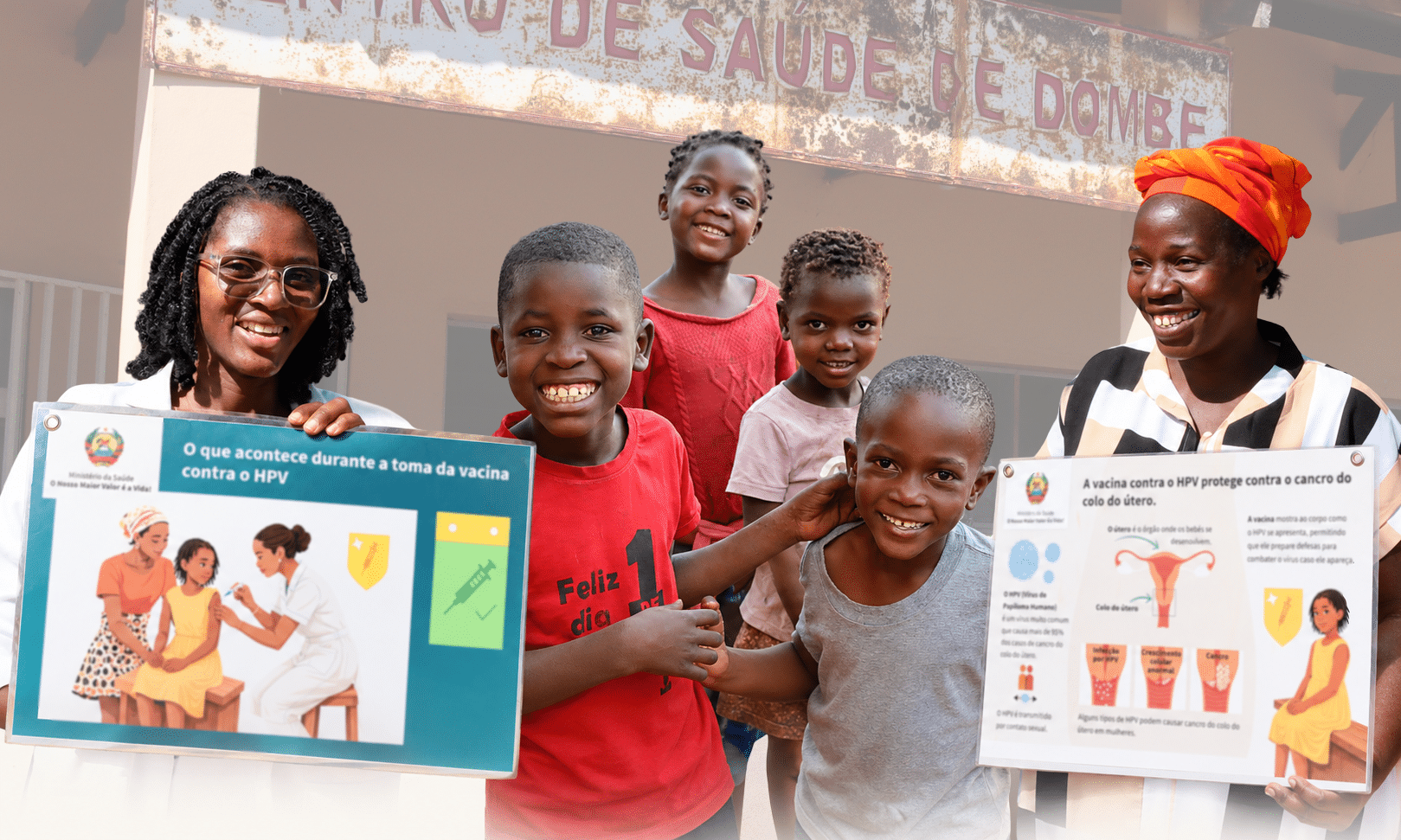
At the community level, VillageReach distributed Information, Education and Communication (IEC) materials to the six participating health facilities in the districts of Vanduzi and Sussungenda, both in Manica Province. These materials were developed through an involved, community-informed process of identifying needs, shaping messages and creating practical visual tools. They are helping health workers, teachers and community actors to educate youth and their families about HPV, and answer the sometimes difficult, taboo and complex questions about HPV vaccination.
At the same time, VillageReach supervised and trained 277 health workers, community actors and teachers during the initial phase of community-based demand-generation activities. The training is helping participants hold practical conversations with different audiences in their community, and use the IEC materials to build community understanding of HPV vaccination and encourage uptake in their communities.
VillageReach and its Health and Education partners are using the Immunization Academy’s IA Learn platform, developed by BCL, to provide participants with flexible, asynchronous training that can be completed alongside their day-to-day work. This digital learning is complemented by peer discussion sessions that bring participants together to reflect on what they are learning, share experiences from implementation, identify solutions to challenges they encounter and develop action plans for applying new knowledge in their respective health facilities.
Together, these activities are helping connect digital learning, peer exchange and practical community engagement to give participants both the knowledge and the tools to put that learning to work.
“The implementation of these activities will help consolidate the practical application of the knowledge acquired by health professionals through the IA Learn platform, ensure the availability of IEC materials at health facilities for subsequent distribution to community actors and teachers and strengthen the quality of community activity implementation, thereby promoting more consistent demand generation,” said Nilsa Mubunda, VillageReach P2P Learning Manager.
Shared Learning and Locally-led Action
As the P2P Learning Initiative rolls out in Mozambique and Nigeria, VillageReach is exploring how collaborative learning can strengthen immunization systems.
Implemented with the Ministries of Health since 2025, the project is testing an approach in which strengthening health worker capacity is not just about transferring knowledge, but also about creating opportunities for people facing similar challenges to learn from one another, test solutions in their own contexts and adapt what works.
There is growing evidence for this approach in African health systems. A study of peer mentoring for immunization workers in Kenya found improvements in knowledge across 11 of 12 technical areas in one participating subcounty and 10 of 12 in another, while research across Ethiopia, Ghana and Mozambique has similarly highlighted peer exchange and opportunities for learning and adaptation within routine primary health care as important contributors to effective capacity strengthening.
The P2P initiative brings this principle to life through two complementary approaches:
Peer Group Learning
Health professionals participate in hybrid learning groups using the Immunization Academy’s IA Learn platform, developed by Bull City Learning. Participants complete practical modules on demand generation, monitoring and evaluation, caregiver communication and other essential immunization skills. Peer interaction reinforces the digital learning, creating space to discuss how new knowledge applies to day-to-day challenges and helping immunization professionals build confidence to put it into practice.

Learning Exchange
Alongside this structured learning, the project uses a Human-Centered Design (HCD) approach to put local experience at the center of problem-solving. Health workers, community members, education representatives and local leaders work together to identify the root causes of HPV vaccine hesitancy and co-create practical solutions designed for their communities.

One message emerged from the co-creation process in Manica Province: building community capacity is essential to increasing confidence in the HPV vaccine.
That insight translated directly into action. The project invested in training a broad network of community actors who are now leading demand-generation activities in participating communities. These activities include community health talks, household visits and local engagement to address myths and misconceptions surrounding HPV vaccination.
The co-creation process also identified the need for practical tools that could make these conversations more engaging and impactful. In response, the project developed a series of user-friendly, pictorial Information, Education and Communication (IEC) materials to support health workers, Community Health Workers (CHWs), Model Mothers, teachers and adolescent champions during health talks.
The materials help make discussions more interactive, improve understanding of key messages and enable community members to make a stronger visual connection with information about HPV, cervical cancer prevention and the benefits of vaccination.
Together, the two strands of the P2P approach create a pathway from learning, through peer exchange, to locally designed action. Health professionals strengthen their skills, peers help one another turn knowledge into practice and communities themselves help shape how information about vaccination is understood and shared.
Signs of Progress
Early results are encouraging. Participation figures show the breadth of engagement across participating communities, an important step toward reaching more adolescents, families and trusted community actors with accurate information about HPV vaccination.
Learning exchange training activities in Manica reached 277 participants:
- 24 Health Technicians
- 44 Community Health Workers (CHWs)
- 45 Teachers
- 108 Caregivers / Model Mothers
- 45 Adolescent Girls (Girl Champions)
- 11 Ministry of Health / EPI Co-facilitators
Improving HPV vaccine uptake means equipping the whole community, from teachers and caregivers to adolescent champions and community health workers, with the knowledge, confidence and practical tools to support informed decision-making and address concerns about vaccination.
Early findings from the Peer Group Learning component also point to gains among health workers themselves. Ninety-one health workers across Mozambique and Nigeria studied the same HPV curriculum while receiving support through three different models: in-person peer groups, virtual peer groups and one-on-one conversations with Maya, an AI-powered mentor.
Across these different forms of interaction, similar patterns are emerging in health worker confidence, readiness to apply learning and technical skills. Some of the areas participants initially found most difficult showed the greatest improvement. Talking with adolescent girls about HPV vaccination, checking the quality of immunization reports and monitoring community engagement began among the lowest-scoring skills in practice assessments. By the final scenario-based assessments, learners were reaching 93% to 95% mastery in these areas.

Three initially difficult skills reached 93–95% mastery in final assessments
Open-ended feedback suggests that learning is also beginning to shape action. Health workers described plans to reach out-of-school girls, engage community leaders, practice newly acquired skills in the field and develop practical tools for tracking and referring girls who have not yet been vaccinated.
These early findings suggest that useful peer learning can take several forms. In-person discussion offers close interaction, virtual groups can connect peers across distance, and AI-supported mentoring provides individual support on demand. Similar trends across the models suggest that the format can be matched to health workers’ circumstances, including connectivity, scheduling and the level of facilitation available.
As implementation of the co-created interventions continues, VillageReach with the Ministries of Health and our partners will continue learning from these approaches and examining their contribution to strengthening immunization systems through innovation, peer learning and community-driven solutions. The promise of the P2P approach is that learning travels: from digital platforms to peer discussion, from health facilities into communities and ultimately into the conversations and decisions that can help more children and adolescents receive a potentially life-saving vaccine.