

The major aid cuts announced by the US and European governments in early 2025 have reshaped the global development funding environment. As donor funding shrinks, global health programs that have long relied on this support are already seeing the effects, particularly on women, girls and children.
Across low- and middle-income countries (LMICs), women face an increased risk of maternal health complications due to service reductions.[1] Community health workers (CHWS), a majority of whom are women, stand to lose tools, support, or their livelihoods. These impacts are already happening.
For instance, USAID has historically provided antiretrovirals (ARVs) to people living with HIV/AIDS. However, the recent funding cuts are disrupting the availability of these medications, disproportionately affecting women, who are more likely than men to be on ARV treatment.[2] These are the short-term effects of the funding cuts. The long-term consequences, however, are yet to be determined and they raise critical questions:
- What will the new funding shifts mean for women’s health and rights?
- How can we prevent decades of gender and health progress from being undone?
To help answer these questions, we evaluated a recent WHO Rapid Assessment on how cessation of overseas development assistance affects health systems. This assessment provides some of the first comprehensive evidence revealing the effects of recent aid cuts on low- and middle-income countries (LMICs), particularly their impact on gender equality and health outcomes.
The assessment found that:
- 56% of WHO country offices reported moderate to severe suspensions on health overseas development assistance
- 80% of countries noted disruptions across at least one health system area
- The most impacted health services areas include malaria, vaccinations, sexually transmitted infections, family planning, maternal and child health, TB, HIV and outbreak responses
- WHO reports indicate that these service disruptions were nearly as significant as during the pandemic [3]
Given the depth of the impact being felt and that the services are largely focused on services that target women, such as family planning and Maternal, Newborn and Child Health (MNCH), we can surmise that women’s access to PHC will be disproportionately affected by the aid cuts
Health workforce challenges
The funding cuts most impacted Community Health Workers (CHWs), doctors and nurses. According to the WHO, 66% of reporting country offices noted disruptions involving CHWs [4]. These impacts included salary suspensions, temporary leave from work, training interruptions and even job loss altogether. Some organisations instituted furloughs or requested volunteer work, while others froze recruitment.[5] Given that 70% of CHWs globally are women, they will be most significantly affected in comparison to their male counterparts.
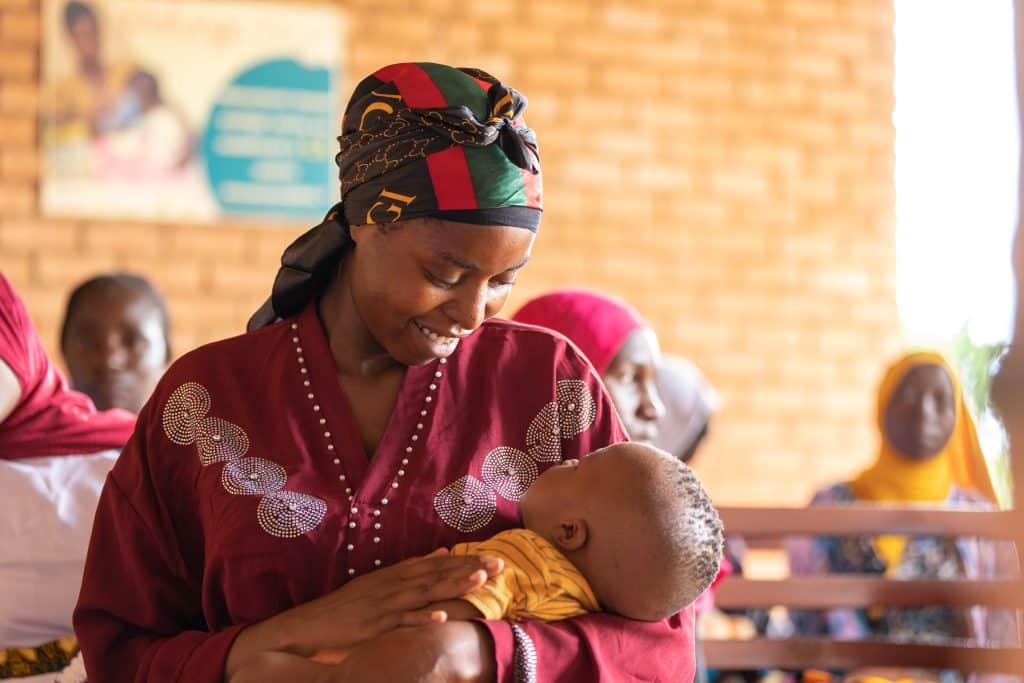
A mother smiling at her child after receiving a vaccine. Location: Jalasi Health Centre, Mangochi, Malawi. Photo credit: Homeline Media
Reduced Access to Essential Services
Cuts to services such as family planning, STI treatment and maternal health are likely to drive up unplanned pregnancies and worsen reproductive health outcomes for women and girls. This is because, when essential services such as health care, education and gender-based violence services are unavailable, women and girls face either long lines for services or risk being turned away.[8]
In LMIC settings, this could have life-changing consequences as women and girls are likely to be susceptible to unplanned pregnancies and sexual violence.
Setbacks to Women and Girls’ Empowerment
According to recent data, 62% of women-focused organizations have had to cut back the services they offer. [6] Only 18% of women-led organizations are certain they will remain operational over the next 12 months.[7]
The impending closure of women’s organizations threatens to halt numerous women’s and girls’ empowerment programs. If these programs disappear, we risk reversing hard-won progress. Already, communities are reporting negative coping mechanisms that will disproportionately affect girls, such as early marriage and transactional sex.
A Gender-Informed Approach Is Not Optional
At VillageReach, we recognize the interconnectedness of gender, health and empowerment. Our Gender Strategy integrates gender throughout the program lifecycle—from design and monitoring to communications and staffing. We intentionally embed gender-specific needs into our theories of change, train our teams on gender sensitivity and promote inclusive, gender-responsive health systems.
This means that we see gender not as a standalone issue but as a lens that shapes how people experience health care, especially in under-resourced settings. We are committed to ensuring that every program we implement meets the needs of women, girls and all marginalized populations.
We encourage others to do the same. Our Gender Guidelines are openly available and can help other organizations to:
- Conduct gender analyses
- Integrate gender into program design
- Adopt gender-sensitive hiring practices
- Foster inclusive, respectful work cultures
What Should be the Next Steps?
This moment demands a strong response from the global community. Funding shortfalls should not be an excuse to sideline gender. Instead, they should prompt us to double down on gender-responsive strategies that work. [11]
We call on:
- Donors and development partners to protect and prioritize gender and health funding in future aid packages and to elevate and fund women-led organizations—especially those at risk of closure.
- Governments and civil society organizations integrate gender into their health systems, policies and programs.
Gender and Health Are Non-Negotiable
Gender matters. The health, rights and dignity of women and girls cannot be an afterthought in new funding models. As we navigate this shifting landscape, we must remember that gender equality in health is not charity, it’s smart, just and essential. Let’s build systems that don’t just work, but work for everyone.
For more information on our gender work, please contact Lanoi Maloiy, Gender and Equity Specialist, here: lanoi.maloiy@villagereach.org
Sources
- [1] https://www.unaids.org/en/resources/presscentre/featurestories/2020/april/20200428_women-more-likely-to-be-on-hiv-treatment
- [2] https://www.unaids.org/en/resources/presscentre/featurestories/2020/april/20200428_women-more-likely-to-be-on-hiv-treatment
- [4] https://www.who.int/publications/m/item/the-impact-of-suspensions-and-reductions-in-health-official-development-assistance-on-health-systems#:~:text=Overview,7%20March%E2%80%932%20April%202025
- [5] https://www.who.int/publications/m/item/the-impact-of-suspensions-and-reductions-in-health-official-development-assistance-on-health-systems#:~:text=Overview,7%20March%E2%80%932%20April%202025
- [6] https://www.who.int/publications/m/item/the-impact-of-suspensions-and-reductions-in-health-official-development-assistance-on-health-systems#:~:text=Overview,7%20March%E2%80%932%20April%202025
- [7] https://www.euronews.com/2025/06/04/they-will-die-foreign-aid-cuts-hit-women-and-girls-the-hardest-as-ngos-face-closure
- [8] https://www.euronews.com/2025/06/04/they-will-die-foreign-aid-cuts-hit-women-and-girls-the-hardest-as-ngos-face-closure
- [9] https://www.unwomen.org/sites/default/files/2025-05/at-a-breaking-point-the-impact-of-foreign-aid-cuts-on-womens-organizations-in-humanitarian-crises-worldwide-en.pdf
- [10] https://www.unwomen.org/sites/default/files/2025-05/at-a-breaking-point-the-impact-of-foreign-aid-cuts-on-womens-organizations-in-humanitarian-crises-worldwide-en.pdf