



How do you support a system that’s already performing well? You recognize its strengths and make tailored improvements. This is what we targeted in Nigeria’s polio lab sample transport (PLST) project.
VillageReach, in collaboration with Nigeria’s National Primary Health Care Development Agency (NPHCDA) and the Centre for Family Health Initiative (CFHI), partnered to enhance the speed and accuracy of polio detection by refining the sample transport system. This included better sample tracking, quicker turnaround of test results and improved data visibility.
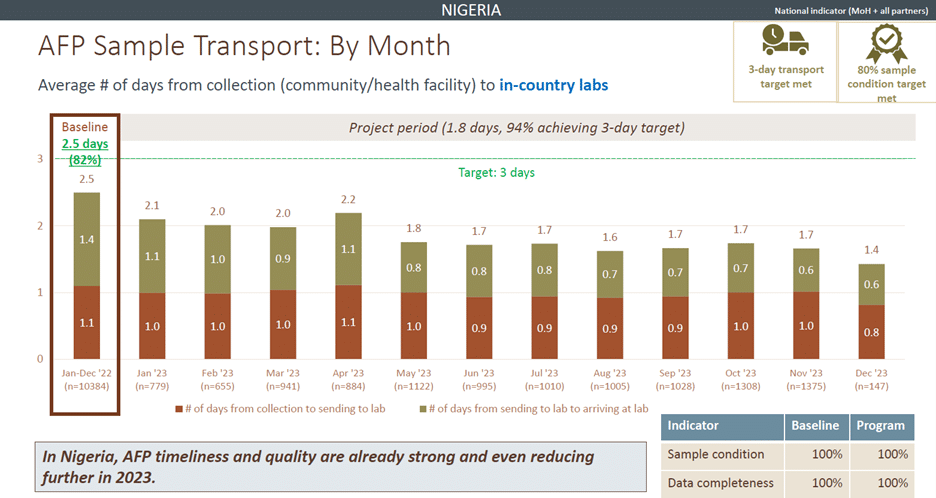
Our initial assessment revealed that Nigeria was already doing well. 82% of samples reached national laboratories within the recommended 72 hours (about 3 days). The quality of samples and the completeness of data at the national level were also commendable.
Targeted Improvements
With these strong foundations in place, we focused on further improving the timeliness of specimen transport in preselected geographies lagging in timeliness of sample transport and specimen quality. Key interventions included training Disease Surveillance and Notification Officers (DSNOs), deploying temperature loggers and partnering with a third-party logistics firm, Riders for Health, to transport samples directly from designated points in Local Government Areas (LGAs) to the respective national reference polio labs.
Before the Partnership
Previously, samples in security-compromised locations were first collected at the state level and then batched—waiting until a sufficient number of samples were gathered before sending them to the national laboratories for testing. This batching process caused delays.
Additionally, the person who collected the samples wasn’t always responsible for transporting them, which led to further delays due to handovers. Moreover, samples from insecure areas could only be transported during the day, further contributing to transportation delays in most cases.
After the Partnership
With the partnership in place, we streamlined the process by transporting samples directly from LGA levels to national laboratories, bypassing the state-level batching. Riders for Health couriers transported polio specimens from 20 LGAs across four states in Nigeria to the national research labs (NRLs). This change reduced transportation time to 1.8 days during the project period from a baseline of 2.5 days. During this period 94% of samples arrived within the 3-day target, speeding up the delivery of test results to affected families.
“This project has shortened the time of anxiety of the parents of affected children. Before, you would wait ‘forever’ for the results. But now, with the transportation shortened, testing gets done fast, and you would get back the results to the parents of the children in good time,” noted Muktar Tukur Ruma, a State Disease Surveillance and Notification Officer in Katsina State.
“We no longer batch samples. As soon as they arrive at the state level, they are immediately sent to the national laboratory, whether one sample or two,” he added.

Key Interventions Included
- Training: 848 DSNOs across Nigeria’s 36+1 states were trained on acute flaccid paralysis (AFP) surveillance feedback, new polio surveillance indicators and the use of temperature monitoring devices for polio sample tracking. In addition, 41 lab personnel from Ibadan and Maiduguri NRL were trained on the usage of temperature monitoring devices.
- ICT equipment was procured and distributed to the 2 National labs (2 desktop computers and 2 UPSs).
- Temperature Monitoring Devices: 1,600 LogTag® UTRIX-16 multi-use USB temperature recorders were procured and deployed for transporting polio specimens from health facilities to the NRLs.
- Third-Party Logistics: Riders for Health was piloted to transport polio specimens from 20 LGAs across four states and a dashboard was deployed to provide visibility into sample tracking during transport. These pilot locations were selected based on data indicating delays in polio sample transport and issues with sample quality.
During the pilot phase (June – November 2023), 171 AFP and environmental surveillance (ES) samples were transported to the NRLs, with 97% arriving within 72 hours. A sample tracking dashboard and notification platform were also introduced to enhance tracking and data visibility.

A rider carrying a sample container in Plateau State, Nigeria
Key Lessons Learned
The project demonstrated that integrating best practices in logistics significantly improved sample arrival times at the NRLs in pilot states. Furthermore, the training of DSNOs strengthened their capacity, improving the overall efficiency of sample monitoring and transportation. Collaboration and partnerships with all stakeholders were crucial in ensuring the project’s smooth implementation.
“We look forward to VillageReach reaching out to other parts of the country to help us respond quicker and earlier to polio outbreaks,” added Muktar Ruma, underscoring the potential for expanding these efforts.
For more information about the Polio Lab Sample Transport program in Nigeria, contact Ms. Krystal Anyanwu, Executive Director, Centre for Family Health Initiative (CFHI) ed@cfhinitiative.org or Mr. Dauda Majanbu, Senior Manager Supply Chain, Dauda.Majanbu@villagereach.org