

In the Democratic Republic of the Congo (DRC), reaching a child with a vaccine is rarely straightforward.
Communities are separated by rivers, forests and vast distances, and heavy rain can make already difficult journeys even harder. Yet reaching people requires more than determination. It requires systems that ensure vaccines, medicines and information get where they are needed, when they are needed.
Understanding the Landscape

Photo Credit: Wolff Mugos
VillageReach’s work in DRC began in Equateur Province, one of the country’s hardest-to-reach provinces, with a supply chain assessment conducted alongside the Ministry of Health (MoH) in 2015. The findings revealed a health system under strain. In some areas, health workers traveled up to 50 kilometers to collect vaccines and medicines, forcing health facilities to close temporarily while they were away. Limited data visibility, inefficient distribution practices and recurring stockouts made it difficult to reliably move vaccines and medicines through the health system.
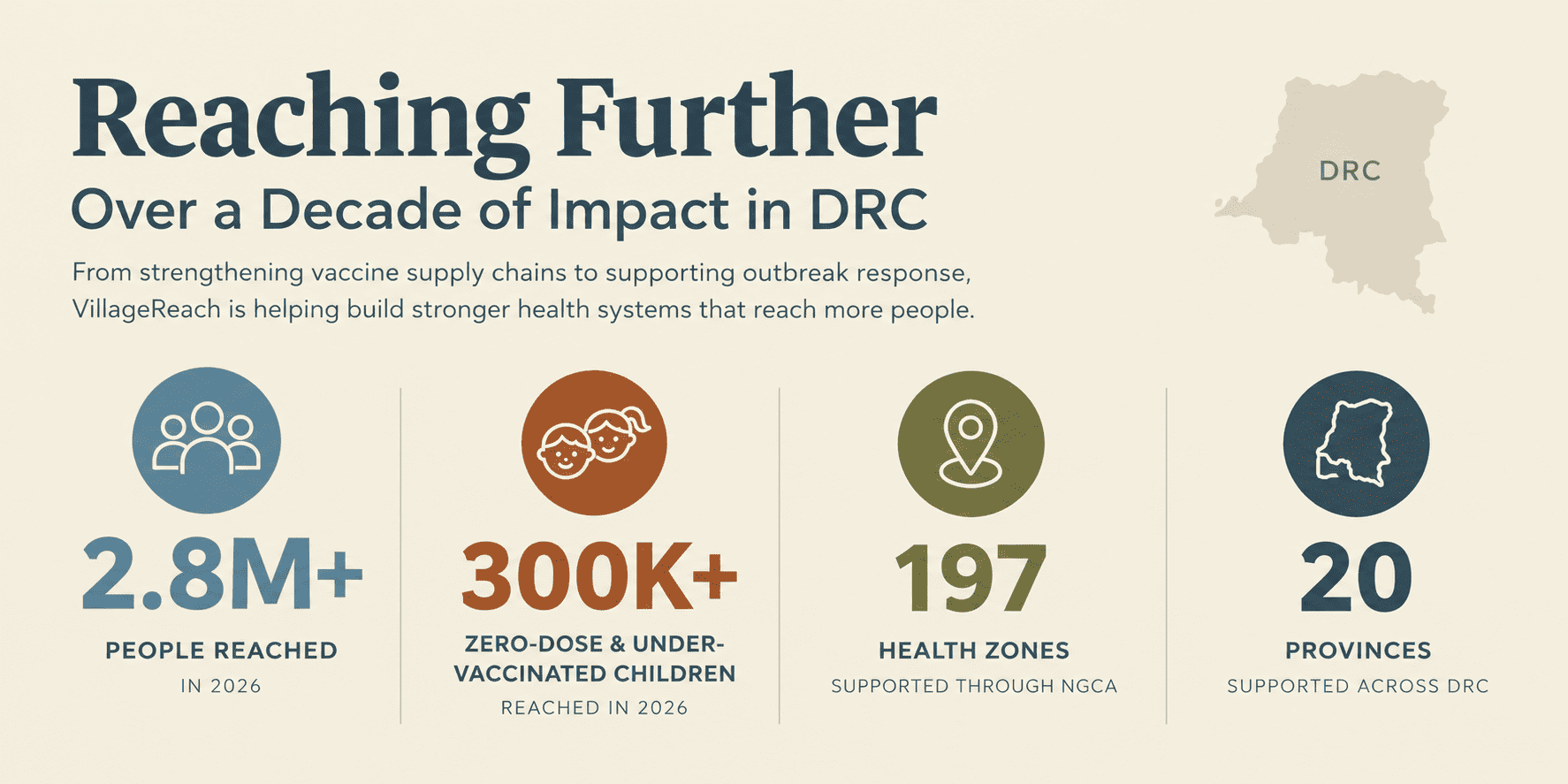
In response, VillageReach and the MoH developed the Next Generation of Supply Chain approach, known in French as Nouvelle Génération de la Chaîne d’Approvisionnement, or NGCA, first launched in Equateur in 2017. By 2024, NGCA had expanded to 197 health zones across 12 of the DRC’s 26 provinces, increasing vaccine availability to more than 76% and reducing average stockout durations from about 20 days to six days.
Learning What Works

Photo Credit: Hervé Kipulu
Even as vaccine availability improved, reaching some communities remained a challenge. In Equateur Province, VillageReach partnered with government and private sector companies to test whether drone technology could help connect remote health facilities to vaccines and other health products.
The pilot demonstrated that drones could improve access by reducing the need for health workers to travel long distances to collect vaccines and medicines, allowing them to remain at their facilities and continue providing care.
Between 2020 and 2023, the program delivered more than 300,000 vaccine doses and helped serve more than 120,000 people in some of Equateur Province’s hardest-to-reach communities. Vaccine availability at supported facilities increased from 65% to 98%, showing how improved transportation could strengthen service delivery while reducing disruptions to care.
Turning Availability into Access
As vaccine availability improved through NGCA and the use of drones, VillageReach expanded its focus from ensuring vaccines reached health facilities to reaching children who were still being missed. Through Periodic Intensification of Routine Immunization (PIRI) activities, VillageReach worked with government partners to combine surveillance, geospatial analysis, community mapping and microplanning to identify under-reached communities and guide targeted vaccination efforts.
VillageReach also supported the training and engagement of community health workers, who played a critical role in connecting families to immunization services. By helping health teams identify priority areas, engage caregivers and bring vaccination services closer to communities, these efforts contributed to the identification and vaccination of more than 300,000 zero-dose and under-vaccinated children through routine immunization and targeted outreach activities in 2026 alone.
In parallel, VillageReach has worked to strengthen DRC’s capacity to detect and respond to polio outbreaks. This has included improving financing mechanisms that accelerate the disbursement of outbreak response funds following confirmation of a case, helping ensure health authorities can act quickly when outbreaks occur.
In northwestern and southeastern DRC, VillageReach supported efforts to map more than 2,400 hard-to-reach communities, including riverine settlements, islands, camps and seasonal population centers often missed during vaccination campaigns and outbreak response efforts. Combining geospatial data, local knowledge and community-level planning helped health teams reach more than 4,500 zero-dose children with the polio vaccine and more than 3,100 zero-dose children with Penta1.
Together, these efforts are helping close immunization gaps while strengthening the systems needed to prevent, detect and respond to outbreaks. In 2026, VillageReach reached more than 2.8 million people in DRC through vaccination and rapid response activities. The investments made in vaccine delivery, community engagement, data use and local planning are helping health teams track coverage, identify immunity gaps and respond more effectively to emerging health threats.
Beyond Vaccines
Over the past decade, systems originally built to deliver vaccines have evolved into platforms that support disease surveillance, laboratory networks, digital health systems and outbreak response.
VillageReach has helped strengthen integrated sample transport systems that move samples from remote communities to laboratories more quickly, improving disease detection and response. This year, sample transport times for mpox were reduced by 70%, while transport systems supported surveillance for diseases including polio, measles, yellow fever, cholera and Ebola. OpenLMIS, locally named “Logimev,” a digital system for managing health products and supplies, launched in Kinshasa and Maniema, improving visibility across the supply chain.
As the DRC responds to the current Ebola outbreak, VillageReach is supporting the MoH through community-based surveillance, including training CHWs to identify suspected cases and engage communities; the transport of Ebola samples for faster diagnosis; distributing personal protective equipment and planning and preparedness as the outbreak evolves.
Looking Ahead

Photo Credit: Hervé Kipulu
A decade ago, VillageReach’s work in DRC began with a simple question: How could vaccines and medicines reach more people, more reliably? Today, we work across 20 provinces, supporting immunization, disease surveillance, outbreak response and health system strengthening.
What began with improving vaccine availability has evolved into a broader effort to build stronger, more resilient health systems. The tools, technologies and approaches may have changed over the years, but the goal has remained the same: ensuring that people can access essential health services when and where they need them.
Because in DRC, reaching further is not just about distance. It is about making health care possible for everyone.